
- Product description: Meta Quest virtual‑reality action‑adventure game
- Release date: November 2025
- Website: Marvel's Deadpool VR
- Product history: Consultant for ClutchplayGames
- Team: Twisted Pixel Games and ClutchplayGames
- Core technologies: Unreal Engine 4, C++, Blueprints
The target hardware, Meta Quest 3, is an impressive piece of engineering, but fitting a full AAA experience onto it required careful optimisation. We focused on baseline framerate optimisation and worked closely with the hitch‑optimisation team to avoid stepping on each other’s work. We also contributed to shared in‑game management systems for advertising screens.
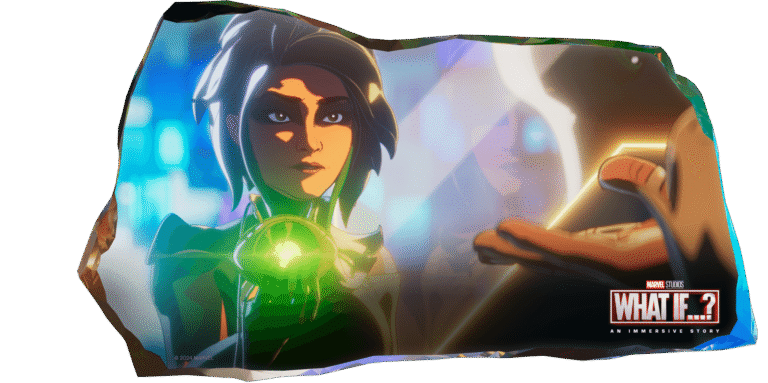
- Product description: Apple Vision Pro augmented‑reality interactive experience
- Release date: May 2024
- Website: What If: An Immersive Story
- Product history: Consultant for ClutchplayGames
- Team: ILMxLAB and ClutchplayGames
- Core technologies: Unreal Engine, Xcode, C++, Swift
We provided Mac‑side Unreal engine support, handling upgrade issues while moving from Unreal 4 to Unreal 5 on Mac hosts and iPad targets. Our experience with the Apple ecosystem let us ramp up quickly on Swift and advise the team on Apple’s development practices. In addition we implemented a rendering path that streams movie files into textures for use in the mixed‑reality pipeline.

- Product description: 3‑D pop‑a‑shot basketball game that reached #29 on the App Store
- Release date: January 5 2010
- Genesis: Built from a previous minigame (Flick Basketball) using our own theComplex engine, with new models and graphics.
- Team: Self, producer, artist, QA
- Core technologies: C++ on theComplex engine, iPhone OpenGL
- Proud of: Integrated a Theora video decoder for backboard animations on devices that lacked native video support.
- Responsibilities: All code except the ball‑throw physics.

All of the 2D user interfaces were implemented using Interface Builder. TheComplex was able to load XIB files directly and create OpenGL-based objects with them, supporting any aspect ratio screen (as would be needed on Android). Later the producer created a free advertisement‑based version without further coding.
Backboard and net movement were animations imported from Maya using the Collada importer of TheComplex engine.
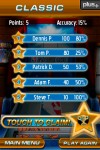
Added synchronized network play with four other players via GameKit (Bluetooth or Wi‑Fi). It synchronizes the game start, then displays scores in real time. Integrated Plus+ leaderboard system.
Built an in‑game “store” where players can purchase additional basketballs and prizes. Performance points earned in the game are redeemable in the store.
We also refined the ball‑throw method: we calculated an ideal angle/speed, then averaged player input to adjust it, yielding a smooth feel for casual gamers. While this worked well, a recently released hit game Skeeball used only the start and end of the swipe to directly map velocity and angle, presenting a greater challenge.
- Full name: Links LS 2000
- Original developer: Access Software
- Original publisher: Microsoft
- Original release date: 2000
- Port commissioned by: Green Dragon Creations, Inc.
- Mac release date: 2000
- Mac publisher: MacSoft
Excerpt from a Mac‑News‑Network review:
Links LS 2000 is a revamped Macintosh version of one of the premiere golf games available for Windows, offering gamers one of the most beautiful and realistic golf simulators available for any computer platform. Links LS 2000 features several modes of play scattered across the game's six beautiful courses that have been modeled after their real life counterparts. Every detail, from sand trap location to the green, has been accounted for. Video-captured players, including Arnold Palmer and Fuzzy Zoeller, contribute to the realism of the game, although the static, pixelated crowds do little to complement the life-like players.
We joined the project late, focusing on bug‑fixing for the Mac port. Our familiarity with the original codebase allowed us to resolve issues quickly and highlighted the importance of unit testing when comparing platforms.